
AI in Medical Diagnostics: What Australian Healthcare Leaders Should Plan for Next
Explore AI diagnostics, ECG monitoring and wearable devices, with practical guidance on clinical validation, privacy and healthcare software in Australia.
Healthcare teams can collect more patient signals than ever, but turning those signals into a timely, trustworthy clinical decision remains the harder problem.
For Australian clinic owners, healthtech founders and hospital technology leaders, the next decade of AI diagnostics starts with that gap. A wearable recording, laboratory result or video-based measurement has limited value if nobody can confirm its quality, review its meaning and act on it. This guide explains where medical AI software can support that workflow, what evidence you should request and how to plan a bounded first deployment. The commercial question is whether your service can deliver useful information with a manageable review burden. More measurements alone do not establish better care, a safer service or a viable business.
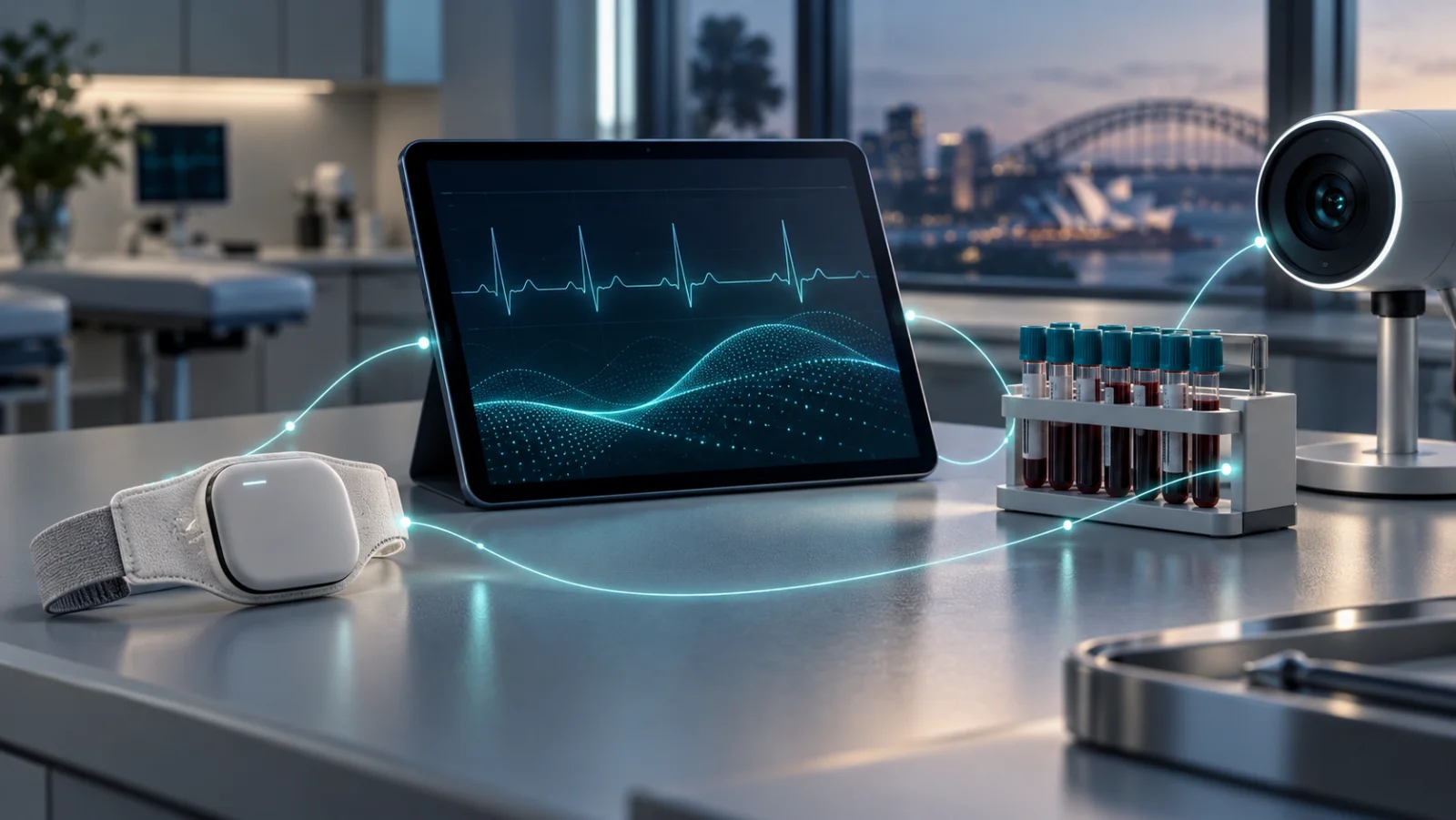
Conceptual illustration of connected diagnostic workflows, not a clinical interface or a validated device.
Contents
- What is changing in AI diagnostics in 2026?
- Where can AI-powered ECG monitoring help?
- What problems do laboratory and connected-device workflows solve?
- Can a camera measure vital signs?
- What could predictive healthcare look like over the next decade?
- What should Australian teams validate before deployment?
- What this costs / what it takes
- Common mistakes
- How should you choose a first diagnostic workflow?
- FAQ
- Discuss your healthcare software brief
What is changing in AI diagnostics in 2026?
AI healthcare solutions are expanding the ways software can analyse measurements and support clinical review. However, measurement, screening, diagnosis and prediction are different tasks. A system that estimates heart rate has not demonstrated that it can diagnose a heart condition.
The WHO’s guidance on AI for health describes potential applications in diagnosis and care while emphasising ethics, human rights and accountability. It does not establish that every product delivers those benefits.
For your healthcare digital transformation programme, start by naming the decision being supported. Is the problem an unread ECG queue, missing laboratory context, fragmented home observations or a delayed escalation? Each requires a different workflow and evidence base.
Where can AI-powered ECG monitoring help?
AI can help organise ECG recordings for review, provided the specific software has been validated for its intended task. Research on portable and wearable ECG analysis illustrates how recordings can enter a common analysis platform. A feasibility study is evidence of a technical approach, not proof of improved outcomes in your clinic.
The practical opportunity is to connect the recording with signal-quality checks, relevant symptoms and a clinician’s review queue. Your software should preserve the original trace, the model version and the reason a recording was flagged.
Consider a regional cardiology service reviewing recordings collected at home. A proposed workflow could reject unusable signals, group recordings by patient and route flagged traces to authorised staff. This is an illustrative design, not a Zimozi client case study. The service would still need device-specific validation and an agreed escalation protocol.
A normal automated result must not become a blanket reassurance message. Define what the product cannot detect and how patients obtain clinical help independently of the application.
What problems do laboratory and connected-device workflows solve?
Laboratory automation and AI solve related but distinct problems. A blood analyser can automate measurements without being an AI diagnostic system. Adding a model does not remove the need for instrument quality control, reliable specimen identification or professional interpretation.
Useful software opportunities include reconciling specimen identifiers, tracking result status and presenting changes alongside the patient’s history. Any model that interprets results needs its own evidence; do not treat accurate instrument output as validation of downstream AI.
For example, a suburban pathology service might first address delayed acknowledgement of results. A status dashboard with clear ownership could solve that problem without predictive modelling. Introduce AI only if there is a defined clinical task it can improve and a way to test that improvement.
Connected monitoring creates a similar integration challenge. Readings need units, timestamps, patient identity, device provenance and a visible indication of missing data. A dashboard should distinguish an old reading from a current observation, and a failed upload from a reassuring result.
Can a camera measure vital signs?
Some camera-based systems estimate pulse or breathing rate from video within a defined intended use. The FDA’s decision summary for optical camera-based measurement describes this device category and the need to interpret its output alongside other patient information.
That does not mean a phone camera can diagnose disease, replace an ECG or reliably measure every vital sign. Overseas authorisation also does not establish permission to supply a product in Australia.
For a proposed telehealth workflow, ask for evidence covering the supported camera, lighting, movement, relevant skin tones and target population. Require an explicit “measurement unavailable” state when conditions are unsuitable. The alternative measurement pathway should be designed before the camera workflow is offered to patients.
What could predictive healthcare look like over the next decade?
The following is a planning outlook, not a forecast of adoption rates or guaranteed clinical outcomes. A plausible direction is to combine longitudinal observations, laboratory results and clinical context to help teams identify patients who warrant review.
An initial deployment might focus on data quality and dependable review queues. A later deployment could evaluate a risk model in a defined patient group. Wider use should depend on prospective evidence, manageable alert volumes and monitoring after deployment.
Prediction creates a new question: what happens after the risk score? If your team cannot explain the proposed action, who owns it and how patients benefit, the score is not ready to drive care. Compare the workflow against existing practice, including the cost of unnecessary follow-up and missed cases.
What should Australian teams validate before deployment?
Establish the product’s intended purpose and regulatory position first. The TGA regulates medical device software according to its intended purpose. Confirm the applicable classification, exclusions or exemptions and Australian Register of Therapeutic Goods requirements with qualified regulatory support. Calling a diagnostic function “decision support” does not settle its status.
Then assess the evidence against your intended users, patients and setting. Request sensitivity, specificity and predictive values at the proposed threshold, plus failure rates and subgroup results. Evaluate how prevalence and signal quality affect performance. A single headline accuracy number is insufficient for a deployment decision.
Health information also needs deliberate handling. The OAIC’s Guide to health privacy addresses collection, notification, consent and privacy processes. Review access, retention, secondary use and overseas disclosure, including relevant state or territory requirements. Australian hosting alone does not establish compliance. Our healthtech data residency guide provides further implementation context.
What this costs / what it takes
Budget for the clinical workflow and its ongoing operation, as well as software development. A credible estimate needs the intended use, integrations, device population, evidence requirements and support model. There is no universal price for an AI diagnostic product.
Your budget should account for:
- Device or software licences and integration rights.
- Data preparation, identity matching and system interfaces.
- Clinical evaluation, regulatory work and documentation.
- Security, privacy controls and audit records.
- Reviewer time, patient support and escalation coverage.
- Model monitoring, controlled updates and incident response.
Measure cost per usable, reviewed observation alongside clinical and operational measures. A cheap measurement can still create an expensive review queue. For general scoping principles, see our AI pilot timeline and completion criteria; diagnostic deployment requires additional clinical and regulatory work.
Common mistakes
The most consequential mistake is allowing a product claim to outrun its evidence. Avoid describing a monitoring feature as a diagnostic service, or a retrospective model result as proof of clinical benefit.
Other mistakes include deploying without a named reviewer, ignoring failed measurements, treating missing data as normal, and changing model versions without assessing their effect. Copying health records into a general-purpose AI tool also creates a separate data-handling decision that must be assessed before use.
How should you choose a first diagnostic workflow?
Choose a narrow workflow with a clear owner and a measurable problem. Before patient-facing use, your clinical, technical and regulatory leads should agree on:
- The precise intended use and excluded uses.
- The target population, devices and operating conditions.
- The evidence required before deployment.
- Review ownership, response expectations and fallback care.
- Baseline measures, acceptance criteria and stop conditions.
- How incidents and software changes will be recorded and reviewed.
A retrospective evaluation may help identify technical failures. A clinically governed silent evaluation, where outputs do not change care, may be an appropriate next step if authorised for your setting. Neither automatically justifies a live diagnostic service.
FAQ
Can we reuse a validated model with a different wearable?
Do not assume so. A different sensor, recording format or patient population can change the input distribution. Check the supported device scope and obtain evidence for the proposed configuration before relying on its output.
Should we build the diagnostic model or integrate existing software?
Compare the available evidence, intended-use fit, integration rights and responsibility for updates. Integrating a suitable product may reduce model-development work, but your organisation still needs to assess the full clinical workflow. Building a model requires a credible data and validation programme.
How should we measure the return on investment?
Track usable recordings, reviewer workload, turnaround time, unnecessary follow-up and clinically relevant outcomes where the evaluation permits. Define those measures before procurement. Do not infer patient benefit from faster processing alone.
Discuss your healthcare software brief
Bring one workflow, its current bottleneck and your intended clinical use to a scoped conversation with Zimozi. We can discuss the software and integration scope alongside the clinical and regulatory expertise your project will need.