
A Practical Guide to Healthcare Software Development in Australia
Plan healthcare software development in Australia, from custom applications and clinical integrations to privacy, testing and reliable platform operation.
A healthcare application succeeds when it fits the care workflow, preserves trustworthy information and keeps working when patients and staff need it.
For Australian healthtech founders, clinic owners and technology leaders, healthcare software development starts with the service you want to improve. A patient portal, referral workflow and diagnostic application can share technical components while requiring very different evidence and operating arrangements. This guide explains how to choose between existing products and custom healthcare software, plan integrations and define a useful first release. You will also learn what to test, budget for and request from a delivery partner. The commercial goal is software that resolves a measurable problem and can be maintained after launch, rather than a collection of screens with an uncertain place in care.
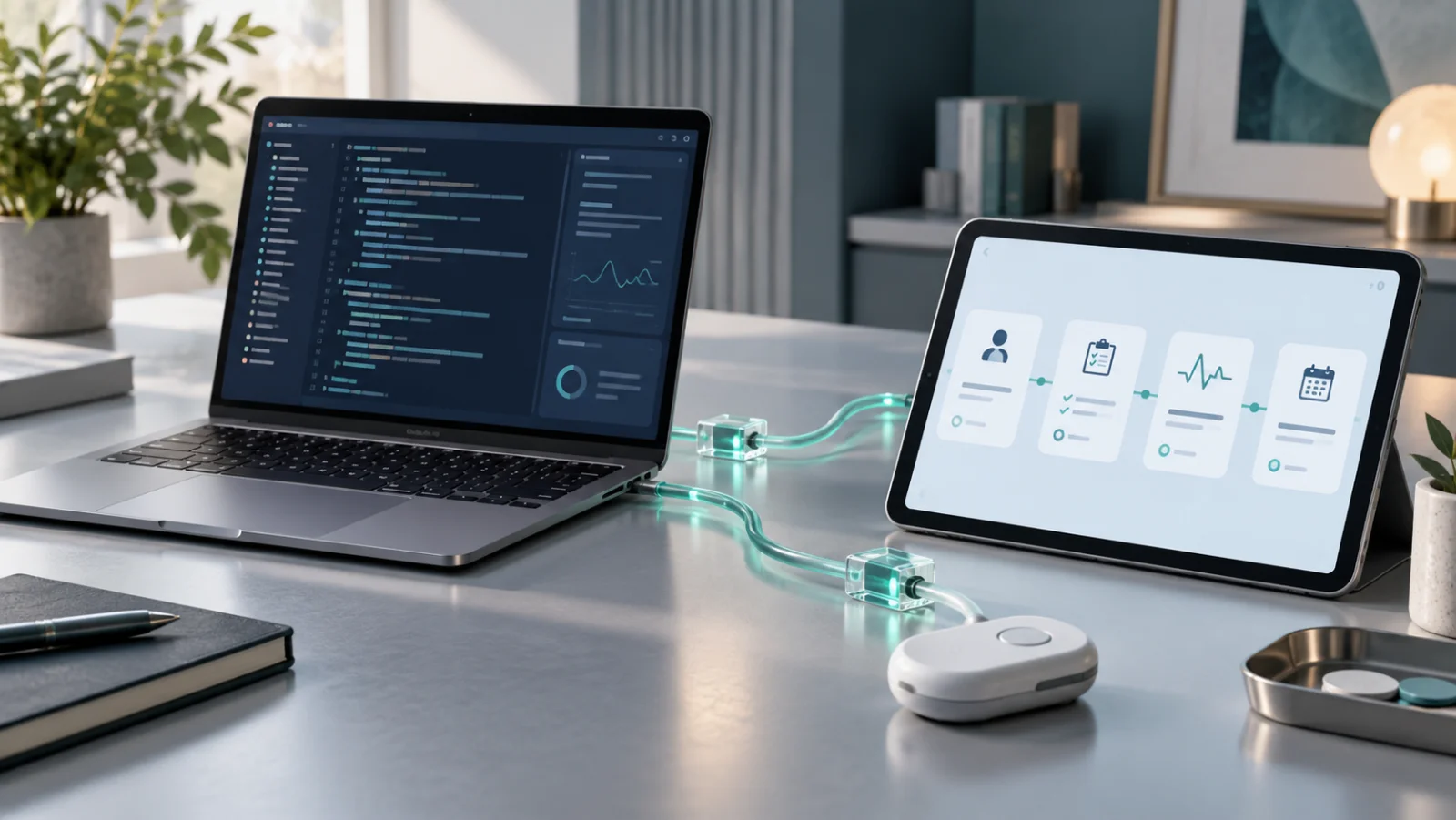
Conceptual illustration of healthcare platform development, not a clinical interface.
Contents
- What does healthcare software development include?
- When should you build custom healthcare software?
- How do you turn a care workflow into requirements?
- How should a modern healthcare platform be structured?
- What makes clinical integration dependable?
- Which Australian obligations should shape the design?
- What should you test before deployment?
- Which developments are worth planning for?
- What this costs / what it takes
- Common mistakes
- How do you select a first release and delivery partner?
- FAQ
- Discuss your healthcare software brief
What does healthcare software development include?
It includes applications and integrations that support healthcare operations, patient participation or clinical work. Examples range from appointment and referral systems to remote-monitoring platforms and software with a diagnostic intended purpose.
The function matters more than the industry label. Healthcare application development for an administrative portal is different from developing a tool that interprets patient signals. Establish the intended use of each feature before choosing an architecture or making clinical claims.
Separate the user experience, information flow and decision responsibility. A portal may display a report without creating it. An integration may deliver an observation without establishing that it has been reviewed. The design should make these distinctions visible.
When should you build custom healthcare software?
Build when a valuable workflow cannot be supported adequately by an existing product or a smaller integration. Assess configuration and procurement options before replacing a platform your staff already depend on.
| Approach | When to evaluate it | Main trade-off |
|---|---|---|
| Configure an existing product | The core workflow is already supported | Work within vendor capabilities and release priorities |
| Add an integration or focused application | Existing systems work but a handoff is missing | Own the interface and its ongoing maintenance |
| Build a custom platform | The differentiated service needs capabilities unavailable elsewhere | Fund development, verification and long-term operation |
Potential benefits of custom healthcare software include a closer workflow fit, deliberate access rules and control over your roadmap. The challenges include maintenance, supplier changes, migration and the evidence needed for the intended use. Custom development is not automatically cheaper or more compliant.
How do you turn a care workflow into requirements?
Map the current process with the people who perform it. Identify the trigger, information needed, responsible role, decision and next step. Include reception staff, clinicians, support teams and patients where relevant.
For an illustrative Australian specialist clinic, a referral application could collect required documents, flag missing information and show the referrer’s submission status. Clinical prioritisation would remain governed by the clinic’s agreed process. This is a proposed workflow, not a client case study.
Write acceptance criteria around behaviour. For example: an incomplete referral is identifiable; an authorised reviewer can record a decision; another clinic cannot retrieve its documents. “A modern dashboard” does not establish any of those outcomes.
Define failure cases during discovery. What happens when a document is unreadable, the receiving system is unavailable or a patient has two records? These cases affect both the application and its support workload.
How should a modern healthcare platform be structured?
Use clear boundaries between the interface, access rules, workflow logic, records and external integrations. The simplest maintainable architecture that meets the requirements is usually a better starting point than a large collection of services.
Keep clinical decisions and record permissions on trusted server-side paths. Separate environments and credentials, and make deployments repeatable. Define where each record is authoritative so two applications do not compete to overwrite it.
For healthcare platform development, plan observation and audit records as part of the design. Staff should be able to distinguish submission, processing, review and correction. Operators need useful diagnostics without copying unnecessary medical content into logs.
Cloud hosting can support the platform, but it does not decide who owns incidents, backups or access reviews. Our secure healthcare application guide covers those controls in more detail.
What makes clinical integration dependable?
Dependable integration preserves identity, meaning and status, as well as transferring data. Confirm what each system can read or write and which vendor permissions or agreements are required.
The Australian Digital Health Agency’s interoperability programme addresses safe information sharing through identity, standards and other coordinated work. Align with the standards and implementation requirements relevant to your interfaces rather than assuming every vendor supports the same exchange.
Check patient matching, units, timestamps, terminology and provenance. Agree how corrected records are represented and how duplicate messages are handled. A successful API response does not prove that the receiving clinician sees the right information.
Design retries and reconciliation deliberately. Staff should be able to identify an incomplete transfer and recover it without creating a second record. Include integration behaviour in vendor acceptance testing, not only in a demonstration with ideal data.
Which Australian obligations should shape the design?
Assess privacy and regulatory scope before development. The OAIC’s Guide to health privacy explains practical obligations around collecting and handling health information. Consider applicable state or territory requirements, overseas access and retention alongside the federal framework.
If you plan My Health Record integration, assess its separate participation, conformance and privacy requirements. Do not describe an application as integrated merely because it can export a file.
The TGA’s software guidance explains how intended purpose determines medical-device status. A new feature involving diagnosis, treatment recommendations or clinical monitoring can change that assessment. Confirm the applicable classification, exclusions, exemptions and supply obligations with qualified support.
Record the scope and revisit it when functionality changes. Regulatory assessment is not a label that remains valid regardless of the product roadmap.
What should you test before deployment?
Test the complete workflow, including the boundaries between organisations, users and systems. Make the verification scope proportional to the intended use and consequences of failure.
Useful checks include:
- Correct identity and permissions for records, files and exports.
- Duplicate submissions, delayed messages and failed integrations.
- Missing or corrected information and its displayed status.
- Accessible forms, keyboard use and understandable error messages.
- Recovery of records and permissions from a backup.
- Monitoring alerts and the operational team’s response path.
Separate software correctness from clinical validation. A feature may perform exactly as implemented without establishing its suitability for a clinical decision. Where clinical evidence is needed, arrange the appropriate evaluation with the responsible experts.
Migration also needs verification. Reconcile record counts and identifiers, inspect representative records and document exceptions. Agree how staff will work during cutover and what happens if reconciliation fails.
Which developments are worth planning for?
Interoperability, connected-device inputs and AI-supported workflows are relevant design considerations. Their relevance does not mean every product needs all three in its first release.
AI can be evaluated for a bounded task, such as drafting an administrative summary for review. Preserve the source, assess errors and prevent the generated output from silently becoming an approved clinical record. Clinical-purpose AI needs its own evidence and regulatory assessment.
Connected devices introduce provenance, compatibility and missing-data questions. Standards-based interfaces can support future integrations, but each new feed still needs evaluation. Treat these developments as roadmap options rather than guaranteed adoption forecasts.
What this costs / what it takes
Budget for the complete lifecycle. There is no universal price for healthtech software development because scope, interfaces, existing records and intended use vary substantially.
Include discovery, design, engineering, integration licences, migration, verification, privacy and regulatory input, training and ongoing operation. If the product uses AI or devices, include data preparation, evaluation and compatibility work.
Model recurring cloud, support and maintenance costs separately from implementation. Confirm who pays when a vendor changes an interface or a clinical workflow changes. A feature estimate that omits these responsibilities is incomplete.
Tie investment to a baseline measure, such as incomplete referrals or manual reconciliation effort. Define how improvement will be measured. Do not infer patient benefit or financial savings solely from faster processing.
Common mistakes
The central mistake is treating healthcare software as a set of screens instead of an operated workflow. Staff may still need spreadsheets and phone calls if ownership and exceptions are unresolved.
Other mistakes include choosing a technology stack before understanding integrations, using real patient records for casual testing and postponing regulatory assessment until launch. Replacing every system at once can also make migration and staff adoption harder to control.
Avoid calling a prototype production-ready because it looks complete. Deployed behaviour, recovery, operating ownership and any required clinical evidence are separate delivery boundaries.
How do you select a first release and delivery partner?
Choose one workflow with a clear owner, measurable problem and manageable integration scope. Define what the release must prove and what remains outside it.
When evaluating a medical software company, ask it to explain a representative failure scenario, its verification approach and how you retain access to the source, infrastructure and records. Request evidence relevant to your workflow rather than assuming an industry portfolio guarantees fit.
Our healthcare engineering team guide explains capability planning and supplier ownership. Agree who provides product, clinical, regulatory, security and operational leadership before contracting the build.
FAQ
Can we add a patient portal without replacing our clinical system?
Potentially, if the existing system supports suitable interfaces and access arrangements. Assess record ownership, identity matching and status synchronisation before committing to that approach.
How should we handle historical data with missing fields?
Document the gaps and their consequences with the process owner. Do not invent values to make migration succeed. Decide which records can be imported, which need review and how limitations are shown to authorised users.
Who should approve changes after launch?
Use a defined change process with product and operational ownership, plus clinical or regulatory review where relevant. Assess the effect of each change on permissions, integrations, evidence and support procedures.
Discuss your healthcare software brief
Bring your intended workflow, current systems and first-release priorities to a scoped conversation with Zimozi. We can discuss the application and integration work alongside the clinical, privacy and regulatory expertise your project needs.