The Australian Privacy Act & Essential Eight: An Engineer’s Blueprint for Secure Web and Mobile Software
Privacy Act and Essential Eight guide for Australian fintech and healthtech: tokenisation, field-level encryption and security controls for custom software.
Australian businesses building web and mobile applications have to meet strict legal and technical standards. The Privacy Act 1988 and the Essential Eight, a set of security controls from the Australian Cyber Security Centre (ACSC), together shape how custom software should handle sensitive data and resist cyber threats. For fintech founders, healthtech operators and compliance officers, building these requirements in from the start costs far less than fixing them after a breach.
This guide is an engineering blueprint. It covers what the Privacy Act expects from your software, how the Essential Eight applies to custom software, and the architecture patterns that protect patient and financial data. It is general information, not legal advice, so confirm your obligations with a qualified adviser.
What the Privacy Act means for custom software
The Privacy Act regulates how organisations collect, use, store and disclose personal information. It applies to Australian Government agencies and to many businesses, including all private health service providers. Its core rules are the 13 Australian Privacy Principles (APPs). For engineering teams, four of them matter most:
- Collect only what you need (APP 3): every field in a sign-up form or mobile app should have a reason to exist.
- Disclose overseas with care (APP 8): if your cloud region, analytics tool or support platform sits outside Australia, you remain responsible for how that data is handled.
- Protect what you hold (APP 11): you must take reasonable steps to protect personal information from misuse, interference, loss and unauthorised access.
- Delete or de-identify (APP 11): when data is no longer needed, your system should be able to remove it.
Health information counts as sensitive information under the Privacy Act, so it needs a higher standard of care. The Notifiable Data Breaches scheme also requires organisations to notify the Office of the Australian Information Commissioner (OAIC) and affected people about eligible breaches. You can read the full principles on the OAIC website. Regulated financial entities and health platforms may have extra obligations on top of this, so check which rules apply to you.
What is the Essential Eight?
The Essential Eight is a set of eight mitigation strategies published by the ACSC to make organisations harder to compromise. It is guidance rather than legislation, but it is a widely used benchmark for what reasonable security looks like. It also defines maturity levels, so you can measure progress. The ACSC publishes the full detail on its Essential Eight page.
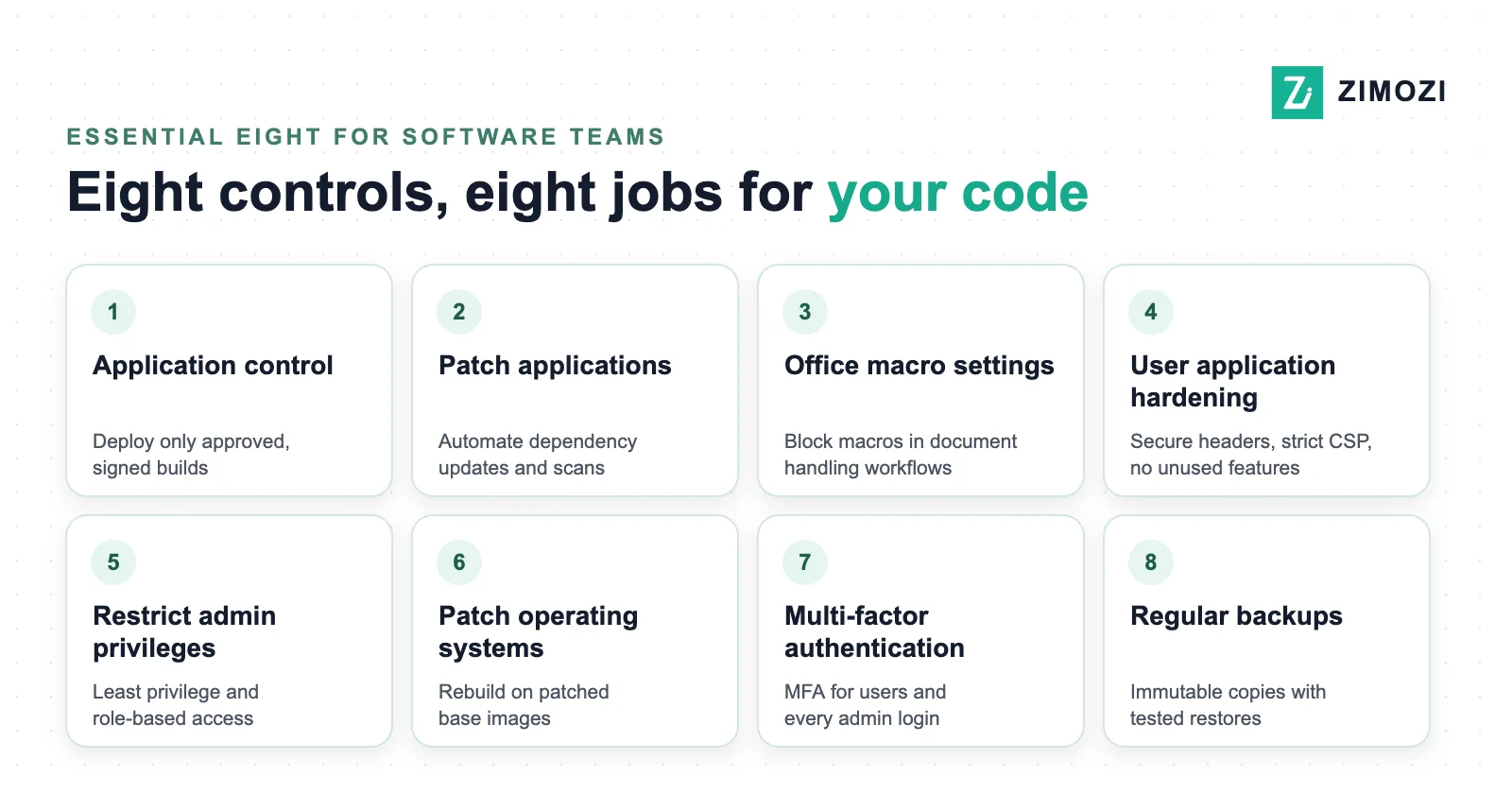
The eight controls are application control, patching applications, configuring Microsoft Office macro settings, user application hardening, restricting administrative privileges, patching operating systems, multi-factor authentication and regular backups. Many teams treat them as an infrastructure checklist, but most of them show up in how custom software is designed and shipped.
How the Essential Eight shapes custom software
- Multi-factor authentication: your application should support authenticator apps or hardware keys, not passwords alone, for both customers and staff.
- Restricting administrative privileges: design strict role-based access. A standard user must never be able to change system settings, and admin accounts should be few, named and reviewed.
- Patching applications: custom software depends on external libraries. Automate dependency scanning and updates in your pipeline so a fix can ship quickly when a vulnerability is disclosed.
- Application control: deploy only approved, signed builds from a trusted registry, so unexpected code cannot run in production.
- User application hardening: use secure headers, a strict content security policy and disable features you do not use.
- Regular backups: build automated database backups that a compromised account cannot delete, and test restores on a schedule.
Security testing supports all of this. Our guide to penetration testing in Australia explains how to check whether these controls hold up, and our cybersecurity compliance checklist for Australian SMEs covers the wider business picture.
A secure architecture for sensitive Australian data
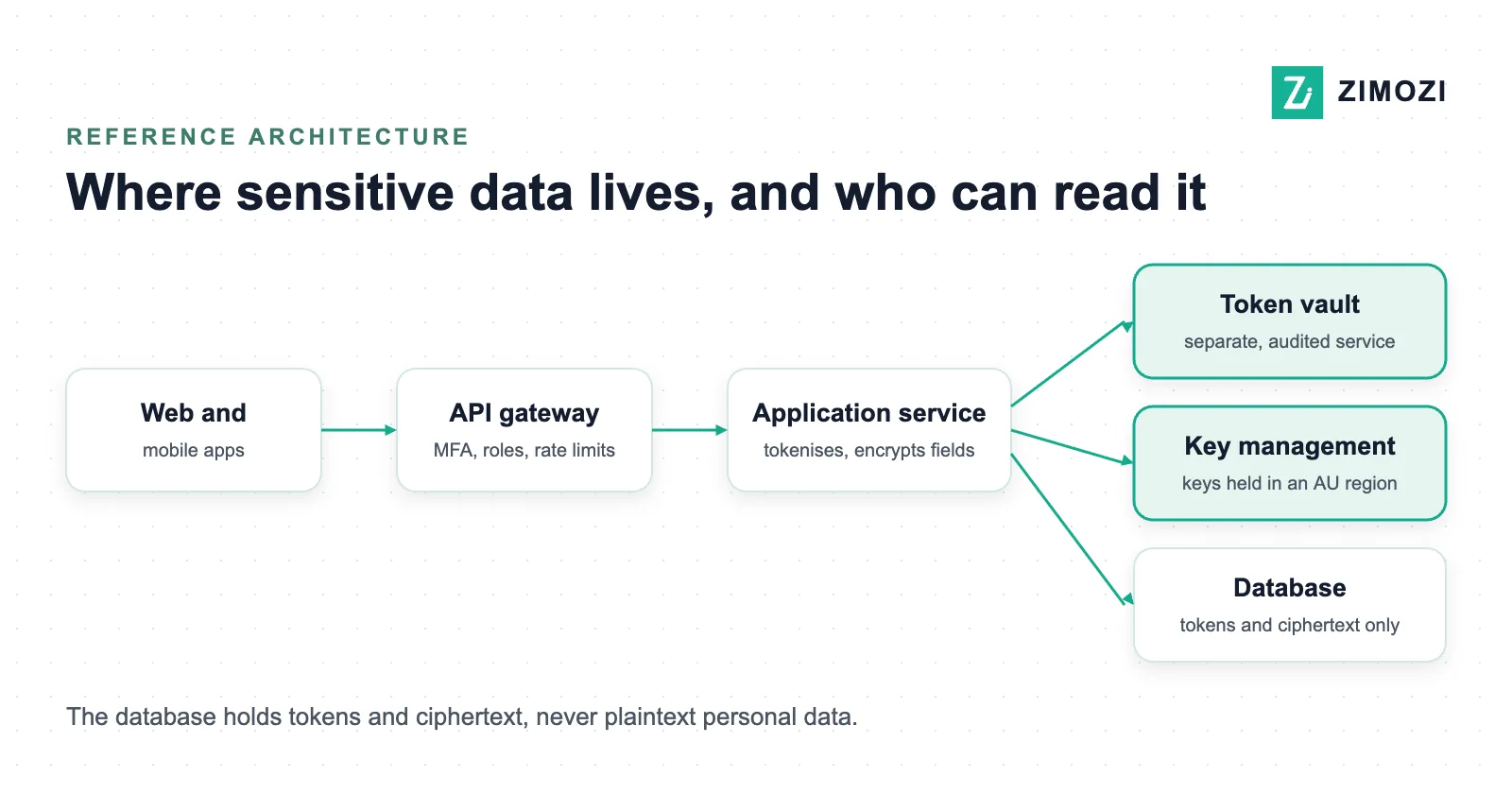
Meeting the Privacy Act in software comes down to one idea: keep sensitive data in as few places as possible, and make it useless if it leaks. The reference architecture below shows one way to do that.
Backend tokenisation
Tokenisation replaces a sensitive value, such as a card number or an identity document number, with a random token that has no meaning on its own. The real value lives in a separate token vault with its own network boundary, its own access rules and full audit logging. Your main application and database only ever see tokens.
This shrinks the part of your system that holds real data. If an attacker reaches the main database, they find tokens rather than personal information. Detokenisation happens only through a tightly controlled service, and every request is logged.
Field-level encryption for patient and financial records
Encrypting the whole database disk is a good baseline, but it does not stop someone with database access from reading records. Field-level encryption goes further by encrypting individual sensitive fields, such as names, Medicare numbers, diagnoses and account numbers, inside the application before they are written. A few practices make this work well:
- Use envelope encryption, where a unique data key encrypts each record or tenant and a master key in a key management service protects those data keys.
- Keep keys in an Australian region and separate from the data, with tight permissions on who can use them.
- Rotate keys on a schedule and plan for re-encryption without downtime.
- Use blind indexes or hashed lookup fields when you need to search encrypted values.
Access control, logging and data residency
Encryption only helps if access is controlled. Use role-based or attribute-based access so staff see only what their job requires, and add a logged break-glass process for emergencies. Keep audit logs tamper-resistant, and never write personal information into application logs. Finally, choose Australian cloud regions for storage and check where every third-party service processes data, because APP 8 applies to overseas disclosure.
Healthtech example: a patient booking app
Consider a business building a healthcare booking application. The software collects patient names, contact details and appointment histories. To meet the Privacy Act, the engineers encrypt sensitive fields, host data in an Australian region and configure the application to delete temporary user data after each session. They set a retention rule so old records are removed or de-identified.
To align with the Essential Eight, they build multi-factor authentication into the patient login portal, restrict access to the medical records database by role, and set up automated checks for outdated code libraries. Backups run automatically and are stored where a compromised account cannot erase them.
Fintech example: secure customer onboarding
A fintech onboarding flow collects identity documents, bank details and consent records. Here the team tokenises account numbers in the backend, encrypts document metadata at field level, and limits who can detokenise values. Admin actions need multi-factor authentication and are logged. If you are building in this space, our fintech and digital solutions team can help you scope the security requirements early.
A compliance checklist for engineering teams
- Map every piece of personal information your software collects, and remove fields you do not need.
- Decide where data is stored and processed, and confirm it meets your APP 8 position.
- Tokenise high-risk identifiers and encrypt sensitive fields at the application layer.
- Enforce multi-factor authentication and least-privilege roles for every user type.
- Automate dependency and operating system updates, and track them.
- Set up immutable, tested backups with separate credentials.
- Log access to sensitive data and keep those logs free of personal information.
- Write and rehearse a data breach response plan that fits the Notifiable Data Breaches scheme.
Building secure custom software with Zimozi
At Zimozi, we build secure systems that align with Australian regulatory standards. We work with companies on web app development, mobile app development, SaaS product development and system integrations. Our DevOps and automation, quality assurance and penetration testing services help keep security controls working after launch.
Our teams design architectures that protect personal data by default. Whether you are launching a new tool for fintech and digital product development or adding AI features and workflow automation, we build security controls directly into the software. If AI is on your roadmap, see our post on AI in mobile apps for the privacy questions to ask first. We start with a clear understanding of your data requirements, so we can apply the right security measures from the beginning.
Final thoughts
Securing custom software takes more than a privacy policy. By following the Privacy Act and the Essential Eight, businesses can build applications that protect their users and reduce the risk of a data breach.
If you are considering a similar application, Zimozi can help define a small first version and assess the technical requirements. Would you like to discuss the idea?