
From ECG to Predictive Care: Building AI Wearables for Remote Patient Monitoring
Explore AI wearables and remote patient monitoring, with practical healthcare app development guidance for Australian teams planning connected care.
A wearable can collect a useful health signal at home, but that signal only supports care when someone can trust it, review it and respond.
For Australian healthtech founders, clinic owners and digital health leaders, AI wearables create an opportunity to connect observations between appointments with a defined care pathway. The product is more than a sensor and a mobile screen. It includes patient onboarding, dependable uploads, clinical review and clear boundaries around what the service can do. This guide explains how to scope healthcare app development for remote patient monitoring, what evidence to request and how to evaluate the full workflow. The commercial question is whether your service can produce useful, reviewed information at a sustainable cost without creating an unmanageable queue of alerts.
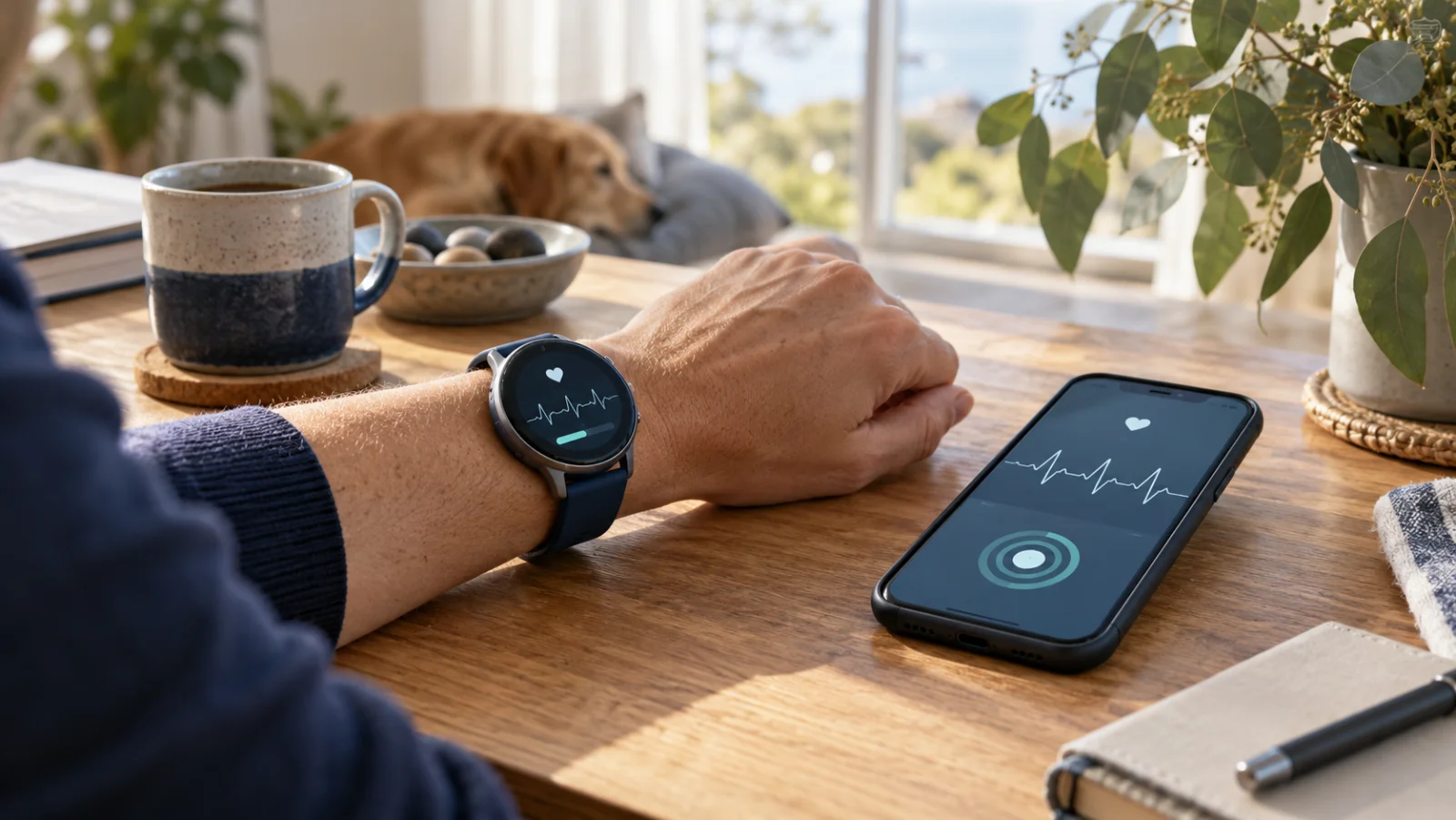
Conceptual illustration of home monitoring, not a validated medical device or clinical interface.
Contents
- What makes an AI wearable different from an activity tracker?
- How can ECG wearables support monitoring between appointments?
- How does a reading become a reviewed clinical observation?
- Does real-time data improve patient outcomes?
- What does predictive care require beyond a wearable?
- What should Australian teams address before launch?
- What this costs / what it takes
- Common mistakes
- How should you scope a first monitoring service?
- FAQ
- Discuss your connected-care application
What makes an AI wearable different from an activity tracker?
An AI wearable combines sensor observations with a model that performs a defined analysis task. The model might operate on the device, phone or backend. Its presence does not automatically make the output suitable for clinical use.
Distinguish the measurement from its interpretation. An optical pulse reading, an ECG trace and a model-generated risk score are different outputs. Each needs an intended use, supported operating conditions and relevant evidence.
The TGA’s wearable medical device guidance notes that software must be validated against the relevant data-collection components or smart device. A model validated with one sensor is not automatically validated with another.
For procurement, ask exactly what the feature measures or identifies. “AI-powered” is not an acceptance criterion. Neither is a product launch evidence that wearables are the fastest-growing healthcare segment.
How can ECG wearables support monitoring between appointments?
Wearable ECG systems can collect recordings outside a clinic and make them available for review. The practical opportunity is to preserve usable traces and connect them with patient context, rather than showing a stream of unexplained scores.
For example, a regional Australian cardiology service could evaluate a workflow in which patients submit recordings under a clinician-defined monitoring plan. The application could attach symptom notes, check upload status and organise recordings for authorised review. This is an illustrative service design, not a Zimozi case study or a clinical recommendation.
Define whether the device records continuously or only when activated, what signal quality is required and which findings the software is validated to identify. Do not infer broad diagnostic capability from one supported task. Our AI medical diagnostics guide explores those evidence boundaries in more detail.
How does a reading become a reviewed clinical observation?
Design the chain from collection to response before designing the dashboard. A useful architecture makes each stage visible and preserves the original observation.
| Stage | What the application should establish | Failure to handle explicitly |
|---|---|---|
| Collection | Patient identity, device, measurement time and signal quality | Device not worn or recording unusable |
| Transfer | Receipt confirmation and duplicate handling | Phone offline or Bluetooth disconnected |
| Analysis | Supported input and recorded model version | Unsupported data or analysis unavailable |
| Review | Assigned reviewer and status | Queue unstaffed or observation overdue |
| Response | Documented action under the agreed care protocol | Patient cannot be contacted |
Measurement time and upload time should be separate. A delayed upload must not appear to be a fresh observation. Store quality and status alongside the value so missing data cannot silently become a reassuring result.
For patients, show clear instructions for fit, charging and reconnection. Use accessible language and test the flow with the intended population. If a service is not continuously staffed, its interface and communications must accurately describe that limitation.
Does real-time data improve patient outcomes?
Faster data availability can support a care workflow, but it does not establish better outcomes by itself. You need evidence for the patient group, intervention and response model you intend to deploy.
In a randomised trial after hip and knee arthroplasty, a programme combining activity monitoring, messaging and links to the care team did not improve its primary discharge-to-home outcome, although fewer rehospitalisations were reported in the intervention group. This was a specific postoperative programme, not a trial proving that AI ECG wearables improve outcomes.
The lesson for product teams is to evaluate the service as well as the sensor. Measure usable observations, reviewer workload, patient engagement and relevant clinical outcomes. Do not attribute a benefit to AI when the evaluated intervention also included staff contact or other support.
What does predictive care require beyond a wearable?
Predictive care requires a validated connection between an input pattern, a future event and a useful action. A changing heart rate or activity trend is not, by itself, a validated prediction of deterioration.
If you propose a risk model, define the event, prediction horizon, patient population and intended action. Evaluate false positives, missed cases, calibration and performance in relevant subgroups. Compare the proposed workflow with existing practice.
Begin with reliable measurement and review before introducing prediction. A prospective evaluation may be necessary to establish whether a model helps the care team and patients in your setting. A technically accurate score can still be impractical if it produces more alerts than the service can safely review.
What should Australian teams address before launch?
Establish the intended purpose of each device and software function. The TGA’s software regulation guidance explains how intended purpose determines regulatory status. Confirm applicable classification, exclusions, exemptions and supply requirements with qualified regulatory support; a “wellness” label does not settle the question.
Map health information across the sensor, phone, cloud services and clinical systems. The OAIC’s Guide to health privacy covers collection, notification, consent and privacy processes. Address access, retention, secondary use and overseas disclosure, along with relevant state or territory requirements.
Treat device and model updates as controlled changes. Record versions, assess compatibility and decide what evidence is needed before an update reaches users. A mobile release should not quietly change the meaning of an observation already being used in care.
What this costs / what it takes
Budget for an operated monitoring service, not just healthcare app development. There is no universal price: the estimate depends on device access, integrations, intended use and the evaluation required.
Include device procurement or licensing, SDK access, onboarding, secure storage, integration work, clinical and regulatory evaluation, reviewer time, patient support and maintenance. Confirm that you can retrieve the raw observations and records if you change suppliers.
For the business case, track cost per enrolled patient alongside cost per usable, reviewed observation. Define what creates value for the buyer: less reconciliation work, dependable follow-up or a clinically evaluated service improvement. Any subscription or service fee also needs a clear account of who provides review and support.
Common mistakes
The most damaging mistake is implying that an app provides continuous clinical supervision when it only uploads data. Define coverage, response ownership and the route to care outside the application before enrolment.
Other mistakes include treating an optical pulse signal as an ECG, confusing an upload confirmation with clinician review, hiding failed measurements and sending model outputs without context. Avoid adding notification volume as a success metric when the extra alerts may simply increase workload.
Do not design for an ideal phone connection alone. Test charging gaps, lost pairing, repeated uploads, travel between time zones and patients who need help using the application.
How should you scope a first monitoring service?
Start with one patient group, one supported measurement and one review pathway. Define these decisions before commissioning the build:
- The intended clinical or operational purpose and excluded uses.
- Supported devices, inputs and operating conditions.
- Who reviews observations and when the service is staffed.
- Failure messages, fallback arrangements and escalation ownership.
- Evidence requirements, baseline measures and stop conditions.
- Responsibilities for support, incidents and controlled updates.
Our AI pilot scoping guide provides general principles for bounded evaluation. A patient-facing monitoring service needs its own clinical governance and regulatory assessment rather than a generic pilot deadline.
FAQ
Can the app work when the patient’s phone is offline?
It can be designed to buffer supported observations, but that depends on the device and SDK. Show the last successful upload, preserve original timestamps and explain that offline collection does not mean the care team has received the data.
Should every unusual reading generate a patient notification?
Not automatically. Agree notification rules with the clinical team and evaluate their consequences. An internal review flag, a request to repeat an unusable measurement and a clinical message serve different purposes.
Can we integrate wearables into an existing clinical system?
Potentially, if the device supplier and clinical system provide suitable interfaces and permissions. Assess patient matching, units, provenance and whether the receiving system can represent review status without losing important context.
Discuss your connected-care application
Bring your intended patient group, wearable platform and proposed review workflow to a scoped conversation with Zimozi. We can discuss the application and integration scope alongside the clinical and regulatory expertise your service will need.