
Healthcare Cybersecurity Threats Every CIO Should Know
Assess healthcare cybersecurity threats, medical data security and connected-device risks, with practical data protection priorities for Australian CIOs.
A healthcare cyber incident can disrupt access to care as well as expose patient information, so security decisions need to address both data protection and service continuity.
For Australian healthcare CIOs, clinic technology leaders and connected-device businesses, the challenge is prioritising risks across an interdependent service. Identity systems, patient portals, suppliers and medical equipment can each create a path to sensitive information or operational disruption. This guide explains the threats worth assessing and the evidence you should request from engineering and operations teams. It also separates healthcare compliance obligations from the controls needed to keep a service running. The commercial goal is a defensible investment plan: fund the weaknesses that matter to your workflows, establish clear owners and verify that protections work before an incident forces the question.
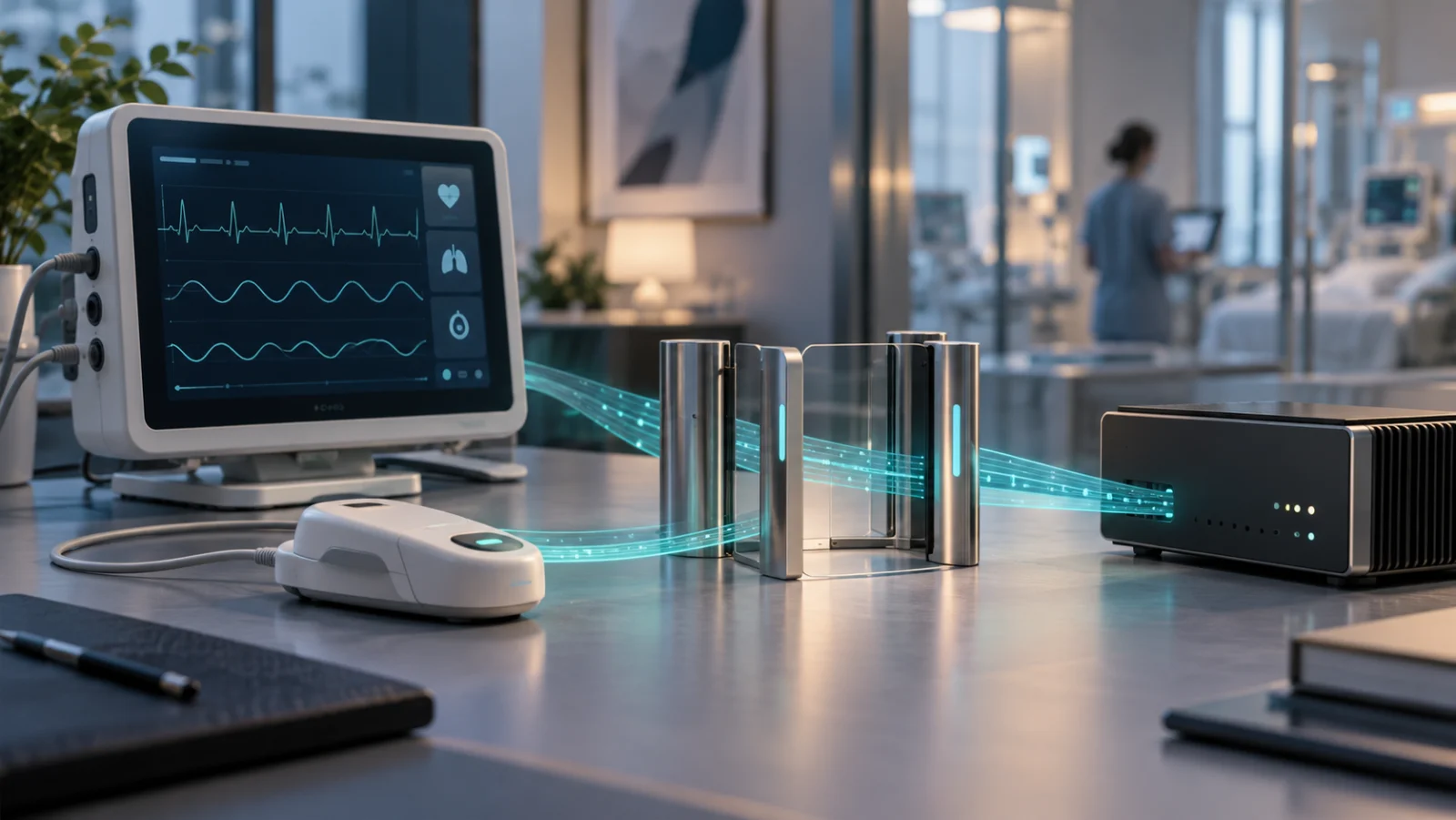
Conceptual illustration of connected healthcare security, not a certified system or an incident reconstruction.
Contents
- Why does healthcare cybersecurity need a service-level view?
- How can compromised identities expose patient data?
- What should CIOs plan for beyond ransomware encryption?
- Where can healthcare applications leak records?
- What risks come with suppliers and connected medical devices?
- How should Australian healthcare compliance shape the response?
- What evidence demonstrates healthcare data protection?
- What this costs / what it takes
- Common mistakes
- How should a CIO prioritise the next security investment?
- FAQ
- Discuss your healthcare security priorities
Why does healthcare cybersecurity need a service-level view?
Because a protected database does not guarantee a dependable care workflow. Staff may also need identity services, clinical applications, messaging, device feeds and external platforms to perform their work.
The ASD Cyber Threat Report 2024–25 describes cybercrime affecting Australian healthcare and an incident involving an electronic prescription service. This is historical evidence of sector exposure, not a prediction of your organisation’s likelihood of compromise.
Map critical workflows and dependencies first. For example, identify what a clinic needs to retrieve a report, contact a patient and document follow-up. Determine what happens if one dependency is unavailable or its information cannot be trusted.
Assess confidentiality, integrity and availability together. Medical data security includes preventing unauthorised access, detecting improper changes and preserving access for legitimate care.
How can compromised identities expose patient data?
An attacker who obtains a valid account may reach information without exploiting the application itself. Phishing, weak account recovery, shared credentials and lingering supplier access are scenarios worth assessing.
Use individual identities and appropriate multifactor authentication, especially for staff, administrators and remote access. Review account recovery with the same attention as sign-in. An easy-to-bypass recovery process can undermine a strong authentication design.
Limit permissions to the role and task. A support account should not inherit unrestricted patient access merely because troubleshooting occasionally requires a record. Define how privileged access is approved, limited and reviewed.
Ask for a demonstration that a departed staff member or revoked supplier account cannot retrieve records, including through active sessions and integrations. An access-removal ticket alone is not evidence of the resulting behaviour.
What should CIOs plan for beyond ransomware encryption?
Plan for theft of information, loss of trust in systems and interruption of care, as well as unavailable files. The Australian Government’s ransomware playbook addresses the wider effects of ransomware and data-extortion incidents.
Protected backups are important, but restoring records does not undo information theft. Establish containment, investigation, recovery, communications and notification responsibilities before an incident.
For an illustrative diagnostic service, a recovery exercise could test whether authorised staff can retrieve reports, confirm their integrity and reconcile activity performed during an outage. This is a proposed exercise, not a client case study.
Measure recovery against the service you need to resume. A successful file restore may still leave identity, permissions or integrations unavailable. Agree fallback procedures with clinical and operational leaders rather than assuming a technical team can define safe continuity alone.
Where can healthcare applications leak records?
Application permissions, file access and exports can expose records even when storage is encrypted. Secure healthcare software must check authorisation for the particular action and record on trusted server-side paths.
For a multi-clinic platform, verify that changing an identifier cannot retrieve another clinic’s report. Apply equivalent checks to attachments, search, downloads and background jobs. Hiding a link in the interface does not restrict the underlying operation.
Data also escapes through notifications, logs, analytics and support tools. Inspect what those systems receive. Minimise medical details in routine diagnostics and review third-party handling before adding new integrations.
For AI features, assess the information transmitted and the permissions granted to any connected tools. A generated answer must not determine access rights or silently become an approved record. Our secure healthcare application guide provides further engineering detail.
What risks come with suppliers and connected medical devices?
Suppliers and devices add dependencies, credentials and software lifecycles that your team may not fully control. Inventory them by function, owner, access and support status, not merely by purchase order.
For a connected device, ask who supplies updates, which versions are supported and how vulnerabilities are handled. Assess network access and restrict communication to necessary paths where feasible. Coordinate changes with clinical engineering and the manufacturer so security work does not disrupt safe device operation.
The TGA’s medical device cybersecurity guidance addresses cybersecurity risk across design, supply and ongoing obligations for manufacturers and sponsors. Provider-side controls and manufacturer responsibilities need to be understood together.
For suppliers, review remote-support access, subprocessors, incident notification arrangements and record export. Contract language is useful, but demonstrate how the access works and how it is removed. A supplier outage can become your service outage even without a breach of your own systems.
How should Australian healthcare compliance shape the response?
Use applicable obligations to inform the control and response plan. The OAIC’s APP 11 guidance describes reasonable steps to protect personal information, including technical and organisational measures. Assess relevant state or territory requirements and contractual obligations as well.
The Notifiable Data Breaches scheme has defined scope and reporting criteria. Arrange timely assessment of a suspected breach and the required response. Do not assume every alert is notifiable, or that restoring a service removes notification obligations.
My Health Record incidents can have a separate reporting pathway. The OAIC’s My Health Record breach guidance explains obligations for relevant reporting entities. Establish which rules apply to your role before an incident occurs.
Healthcare compliance is broader than a penetration-test result or a cloud provider’s certification. Keep a record of scope, responsible people, implemented controls and evidence, and review it as the service changes.
What evidence demonstrates healthcare data protection?
Request demonstrated behaviour tied to the deployed service. Policy documents and dashboard scores are useful inputs, but they do not establish every control’s effectiveness.
| Risk area | Evidence a CIO can request |
|---|---|
| Identity compromise | Staff authentication and account-recovery review; access revocation test |
| Record exposure | Negative tests for cross-patient and cross-clinic access |
| Data extortion | Reviewed privileged access, useful detection and incident-response exercise |
| Service disruption | Successful recovery of the workflow, including identity and permissions |
| Supplier access | Inventory of grants, access review and demonstrated removal |
| Device risk | Supported-version inventory, update responsibilities and assessed exceptions |
Treat coverage gaps explicitly. Record which systems were assessed, when evidence was collected and what remains unverified. A test of one portal does not cover every clinical application or device in the organisation.
What this costs / what it takes
Budget for discovery, remediation and ongoing operation. There is no universal price for healthcare cybersecurity: the number of systems, dependencies, access arrangements and critical workflows determines the work.
Include identity improvements, application fixes, device and supplier reviews, logging, recovery exercises and independent verification where appropriate. Allocate time for clinical and operational teams to assess changes and continuity procedures.
Separate tool costs from the people and processes that operate them. An alerting platform needs an owner, triage and a response pathway. A patching policy needs a practical process for supported devices and documented treatment of exceptions.
Tie investment to reduced exposure or a demonstrated recovery capability. Avoid promising that a product purchase eliminates healthcare cyber attacks or guarantees compliance.
Common mistakes
The central mistake is declaring security complete because one assessment passed. Applications, suppliers, users and supported software versions change after the report is issued.
Other mistakes include leaving shared accounts active, relying on encryption to compensate for excessive permissions and maintaining backups without practising recovery. Treating clinical equipment as ordinary office hardware can also overlook compatibility and patient-safety considerations.
Avoid broad threat claims without evidence. Prioritise your actual exposure, critical workflows and verified gaps rather than assuming that every headline incident implies the same remedy for your organisation.
How should a CIO prioritise the next security investment?
Start with critical workflows and a current exposure review. Assign each material gap an owner, affected service, consequence and verifiable remediation outcome.
First address pathways that can expose many records or block essential operations, taking clinical safety and change constraints into account. Then test recovery and response for the remaining risk. Keep unresolved exceptions visible to the responsible leadership.
For software changes, agree delivery evidence that separates local checks, deployment and live verification. Our healthcare software development guide explains how to make those boundaries part of engineering acceptance.
FAQ
Should we disconnect a medical device as soon as a vulnerability is announced?
Assess the specific exposure and patient-safety implications with clinical engineering, the manufacturer and security specialists. Apply an authorised mitigation plan rather than changing a clinical device’s connectivity without understanding its function.
Can small clinics use the same approach as larger health services?
The principles scale, but the scope and operating model differ. A small clinic can start with critical systems, individual accounts, supplier access and a practised recovery process. Assign responsibility even when an external provider performs the work.
How often should we review security?
Set a risk-based review schedule and reassess when the service changes. New device feeds, suppliers, AI features and user roles can create new exposure. Maintain ongoing vulnerability handling rather than relying solely on periodic assessments.
Discuss your healthcare security priorities
Bring your critical workflows, known gaps and supplier dependencies to a scoped conversation with Zimozi. We can discuss software and integration improvements alongside the clinical, privacy and specialist security expertise your organisation needs.