
Digital Transformation for Medical Device Manufacturers: ERP, AI and Automation
Plan medical device software development, ERP integration and manufacturing automation with practical guidance on traceability and quality in Australia.
When purchasing, production, quality and servicing hold different versions of the same device record, every handoff becomes a reconciliation task.
For Australian medical equipment manufacturers and diagnostic product businesses, digital transformation should start with these operational gaps. You need to know which components entered a device, which checks were completed and which version reached the customer. This guide explains how ERP, quality systems, custom software and carefully scoped AI can support that work. It also separates internal manufacturing applications from software with a medical intended purpose. The commercial goal is a more dependable flow of orders, evidence and service information. A useful investment should address a measurable bottleneck while preserving the controls your quality team needs to trust the result.
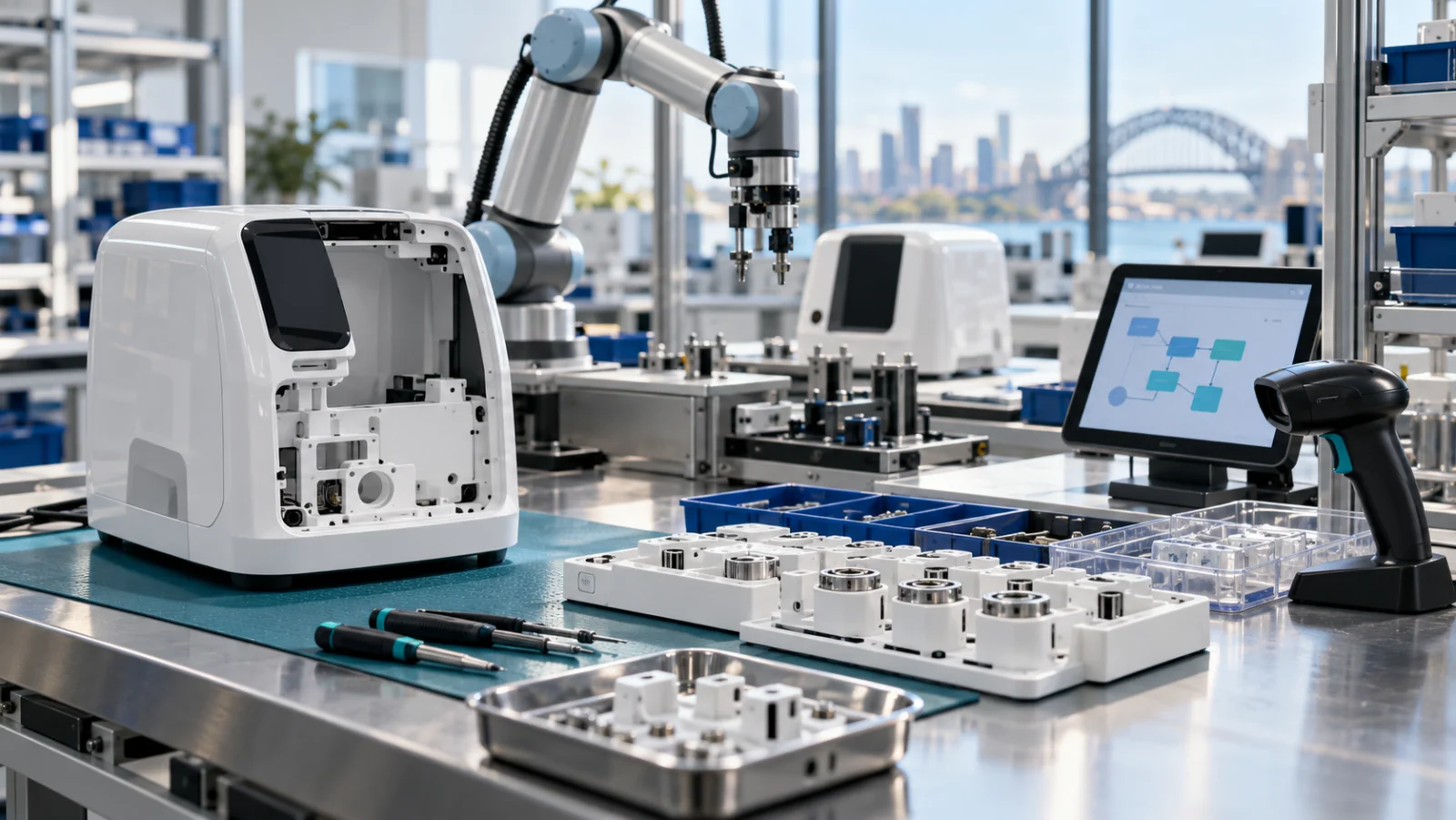
Conceptual illustration of a connected manufacturing workspace.
Contents
- Why prioritise digital transformation in medical manufacturing?
- How should ERP, production and quality systems work together?
- Where does custom software development add value?
- Which automation and AI use cases are worth evaluating?
- What should Australian manufacturers know about traceability?
- How should you validate changes and protect connected devices?
- What this costs / what it takes
- Common mistakes
- How do you choose the first implementation?
- FAQ
- Discuss your manufacturing software brief
Why prioritise digital transformation in medical manufacturing?
Prioritise it when disconnected records are creating rework, slow decisions or incomplete evidence. That is a stronger business case than buying software because competitors appear to be doing so. This article does not assume a measured industry-wide acceleration in adoption.
Typical discovery questions include: how long does it take to assemble a device’s production history? Can your team find every shipment associated with a component lot? Does servicing know the installed software version? Answers reveal where healthcare manufacturing automation might help.
The regulatory context makes evidence management consequential. The TGA’s guidance on demonstrating compliance with the Essential Principles explains that manufacturers must maintain supporting evidence and make it available on request. A digital system can organise that evidence; its existence does not prove compliance.
How should ERP, production and quality systems work together?
Give each system a clear responsibility, then define how records move between them. Enterprise resource planning (ERP) usually handles purchasing, inventory, orders and finance. A manufacturing execution system (MES), where needed, records shop-floor work. An electronic quality management system (eQMS) manages controlled quality workflows.
The names matter less than the actual capabilities. Check whether your selected products can represent your production steps, revision controls, review responsibilities and audit history.
| Record or decision | Suggested system responsibility | Integration question |
|---|---|---|
| Purchase order and stock receipt | ERP | How are supplier and lot identifiers preserved? |
| Build execution and test observations | MES or production application | Which approved instruction revision was used? |
| Nonconformance and corrective action | eQMS | How does a quality hold reach production and dispatch? |
| Product design revision | Controlled engineering repository | How does a released change update the build configuration? |
| Installed device and service history | Service application | Can technicians retrieve the serial number and approved software version? |
Decide which system is authoritative for each field. An interface should carry ownership and status, not create a second editable copy with competing values.
Where does custom software development add value?
Custom development is useful for gaps between established systems, specialised device interfaces and workflows that standard products cannot support economically. Configure existing capabilities before commissioning a replacement ERP or quality platform.
Consider an Australian manufacturer assembling diagnostic instruments. A proposed application could associate a component scan with a work order, capture test output from a station and route the completed record for quality review. If a required test is missing, the workflow could prevent progression according to approved rules. This is an illustrative design, not a client case study.
Medical device software development can also mean software embedded in a product or a standalone application with a medical purpose. That scope differs from an internal stock dashboard. The TGA’s software and AI guidance bases regulation on intended purpose. Assess each function rather than assuming every application in a medical business has the same regulatory status.
Which automation and AI use cases are worth evaluating?
Start with predictable rules where the decision is already defined. Barcode capture, required-field checks, status synchronisation and overdue-task routing may solve the problem without a model.
AI is a candidate when interpretation is necessary and you can evaluate its errors. Possible projects include drafting service-report summaries, sorting supplier documents for review, or evaluating visual inspection against a labelled defect dataset. These are opportunities to test, not promises of accuracy or savings.
Keep the consequence of each output explicit. A document assistant can suggest a classification while preserving its source. A proposed inspection model needs evidence for the relevant defect types, operating conditions and acceptance thresholds. Do not let an unvalidated suggestion release a device or close a quality investigation.
For AI features that affect patient measurements or clinical interpretation, plan a separate clinical and regulatory evaluation. Our AI diagnostics guide explains why measurement, screening and diagnosis require different evidence.
What should Australian manufacturers know about traceability?
Build traceability around stable identifiers and linked events. You should be able to follow the relevant product configuration from materials and assembly through review, shipment and servicing. Determine the required detail with your quality and regulatory leads.
Australia’s Unique Device Identification (UDI) requirements have phased implementation dates. Use the TGA’s current UDI timeframe guidance to assess your device classes, transition arrangements and responsibilities. Do not apply a single deadline to every product.
UDI introduces identification and data obligations; a barcode does not replace your complete production history. Plan product master data, label generation, identifier validation and the applicable AusUDID submission workflow together.
An example discovery exercise is to select a shipped instrument and reconstruct its component lots, test results, approved configuration and service events. Record every manual lookup and missing link. Then design the smallest change that closes a meaningful gap, rather than simply digitising the existing spreadsheet.
How should you validate changes and protect connected devices?
Define the intended use of the system and the consequences of failure before setting your validation approach. The quality team should assess what evidence is needed for software used in production or quality processes. A successful demonstration is not sufficient evidence that every relevant workflow behaves correctly.
For a proposed integration, test the failure cases as well as the normal path: repeated messages, failed scans, expired sessions, missing results and network outages. Preserve approved records and make corrections attributable. Establish how a change is reviewed, deployed and recovered if it fails.
Where the product includes software or electronic components, review its cybersecurity obligations separately. The TGA’s medical device cybersecurity guidance connects cybersecurity risk management with quality and risk frameworks. Define supported versions, update procedures and vulnerability handling alongside product development.
Internal systems also need role-based access, backups and monitored integrations. A service portal should expose only the information its users need. If it handles patient information, that creates an additional privacy assessment rather than a routine extension of inventory management.
What this costs / what it takes
Budget for process design, data cleanup and validation as well as coding. There is no reliable universal price for a medical manufacturing transformation. The estimate depends on systems, sites, interfaces, equipment and the risk of the affected processes.
A scoped budget should include licences, integration work, migration, approved workflow design, validation evidence, operator training and support. Include the cost of maintaining interfaces when a vendor changes an API or your product configuration changes.
For the business case, measure the current reconciliation time, incomplete records, production holds and service lookup effort. Compare those baselines with the proposed workflow. Avoid presenting reduced manual work as a guaranteed saving before the process has been evaluated.
Digital transformation consulting is most useful when it turns those observations into an implementation scope with named owners and acceptance criteria. A roadmap without a funded first workflow and a support plan is difficult to act on.
Common mistakes
One common mistake is treating an ERP purchase as the whole programme. Purchasing and finance can be well organised while production evidence and service history remain disconnected.
Other mistakes include migrating duplicate identifiers, allowing interfaces to overwrite approved values, adding AI before fixing data quality, and assuming a vendor certificate covers your configured workflow. Automating a release decision without agreed quality controls can also move the bottleneck into a less visible place.
Avoid replacing every system at once. A controlled integration can be a better first investment when the existing platforms still perform their primary jobs.
How do you choose the first implementation?
Choose a workflow with a visible problem, a responsible process owner and accessible source records. For example, linking test results to a serialised build may be easier to evaluate than replacing the entire factory stack.
Before development, agree on:
- The current process and its measurable failure or delay.
- The authoritative identifiers and systems involved.
- The review and release decisions that remain controlled.
- The validation evidence and acceptance criteria.
- The migration, fallback and recovery approach.
- Who supports the workflow after rollout.
Our AI pilot scoping guide offers general principles for bounded evaluation. Manufacturing and quality workflows need their own risk assessment; do not inherit a generic AI pilot timeline as a validation commitment.
FAQ
Can we keep our existing ERP and add a custom production application?
Yes, if the available interfaces and ownership model support it. Assess API access, licensing, data consistency and outage handling first. Avoid an application that silently becomes a second inventory ledger.
How should a smaller manufacturer evaluate software vendors?
Use a representative workflow with realistic records and failure scenarios. Ask vendors to demonstrate revision control, traceability, exports, permissions and integration behaviour. Check how you can retrieve your records if you change suppliers.
Should servicing be included in the first project?
Include it when the selected problem depends on installed-device information. Otherwise, define the future interface and keep the first scope bounded. Service history becomes more useful when it is reliably linked to the exact device and configuration.
Discuss your manufacturing software brief
Bring one production, quality or service bottleneck to a scoped conversation with Zimozi. We can discuss the integration and software work alongside the manufacturing, quality and regulatory expertise your project needs.