
The Business Case for Remote Patient Monitoring in Australia
Build a business case for remote patient monitoring, covering connected devices, patient monitoring software and digital health solutions in Australia.
Connected devices can bring patient observations into a care team’s workflow, but a viable monitoring service needs a funded response pathway as well as a data feed.
For Australian clinic owners, healthtech founders and healthcare operations leaders, remote patient monitoring is a service-design decision before it is a device purchase. You need to decide which patients it serves, who reviews the observations and how the programme pays for itself. This guide explains how connected medical devices, patient monitoring software and telehealth technology fit together. It also shows how to assess benefits, ongoing costs and a bounded first deployment. The commercial goal is a dependable service with useful information and manageable workload. More readings are not automatically better care, and an attractive dashboard is not evidence of a sustainable business case.
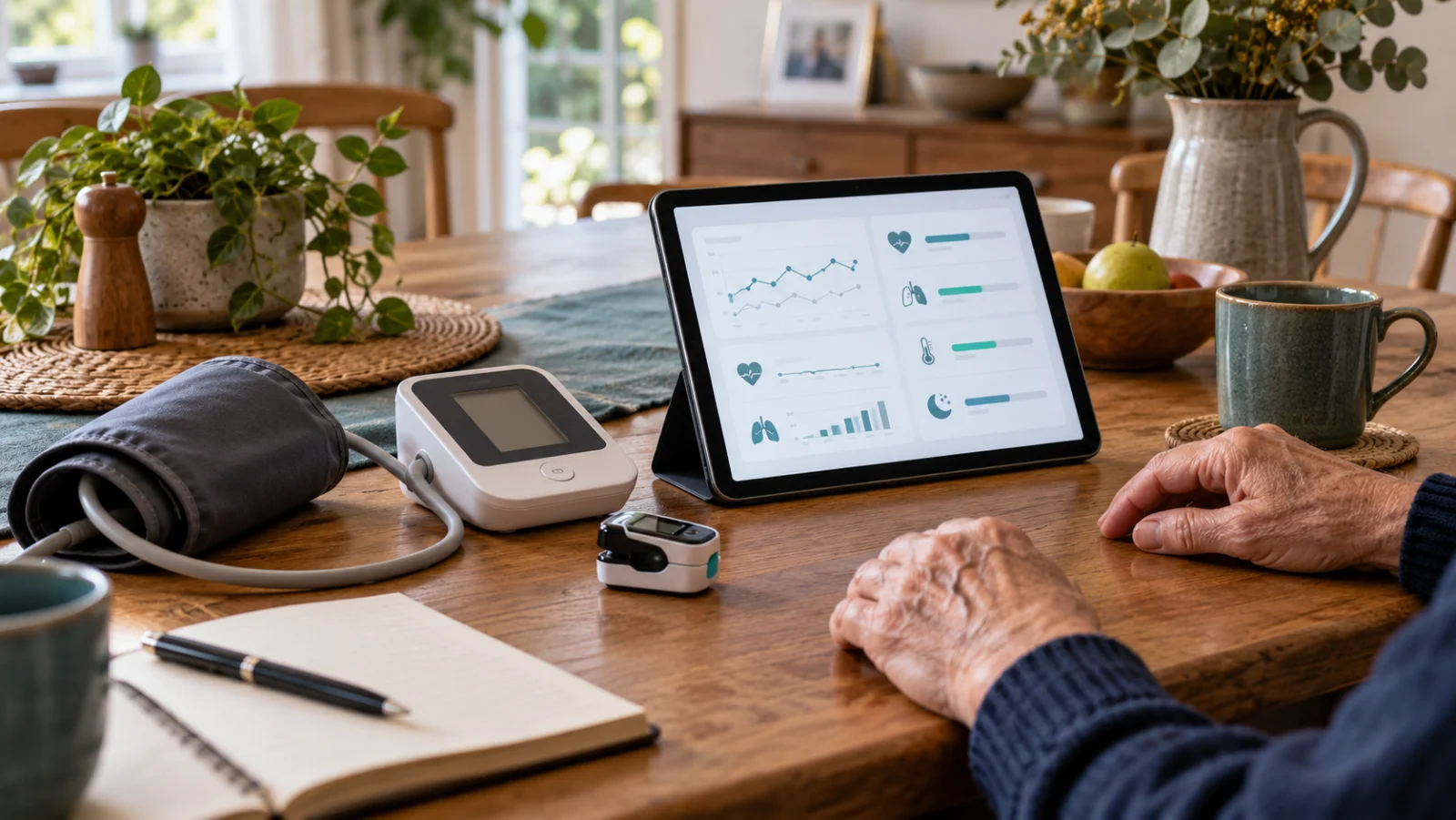
Conceptual illustration of home monitoring, not a clinical interface or a product endorsement.
Contents
- What is remote patient monitoring?
- How do connected devices fit into the care pathway?
- How should you assess patient outcomes and operational value?
- What should patient monitoring software provide?
- Where can AI support continuous health monitoring?
- Who pays for a remote-monitoring service?
- What this costs / what it takes
- Common mistakes
- How should you scope a first programme?
- FAQ
- Discuss your remote-monitoring brief
What is remote patient monitoring?
Remote patient monitoring (RPM) uses software and medical devices to support observation and care outside a traditional clinical setting. The Australian Digital Health Agency describes RPM in these terms, including use at home or in remote areas.
Examples of possible inputs include supported blood pressure measurements, ECG recordings and other observations selected for the intended care pathway. Which readings are appropriate is a clinical decision, not a default software feature list.
RPM differs from a video appointment. Telehealth technology may help a clinician discuss a finding, while RPM supplies observations between interactions. Digital health solutions become useful when those parts are connected to a defined service rather than separate applications with no shared ownership.
How do connected devices fit into the care pathway?
Treat a device as one part of a chain: enrolment, measurement, transfer, review and response. Each step needs an owner and a visible status.
In an illustrative regional Australian programme, patients could take clinician-selected measurements at home. A supported device or phone application would transmit them to an authorised team. The team would review observations under an agreed protocol and arrange follow-up where appropriate. This is a proposed workflow, not a client case study or a recommended treatment plan.
Healthcare IoT describes the connected-device layer. It does not establish who checks the reading or whether the service is continuously staffed. Define those responsibilities separately.
Plan for low connectivity, charging problems and patients who need assistance. A delayed upload should retain its original measurement time, and the patient should be able to tell whether the care team has received it.
How should you assess patient outcomes and operational value?
Assess the complete intervention against existing practice. Avoid assuming that connected devices improve outcomes in every patient group or that additional monitoring necessarily reduces service use.
A systematic review of economic evaluations in chronic disease found that RPM cost-effectiveness depended on clinical context, capital investment, organisational processes and willingness to pay. That supports a setting-specific business case rather than a universal savings claim.
Distinguish clinical outcomes from operational measures. A faster upload is a technical result; shorter review turnaround is an operational result; improved patient health requires appropriate clinical evidence. Record these separately so an early software success does not become an unsupported outcome claim.
Useful programme measures may include usable observations, review workload, patient participation, follow-up activity and relevant clinical outcomes. Define the measures with the clinical team, and account for patients who cannot use the technology or stop participating.
What should patient monitoring software provide?
It should turn observations into accountable work while preserving context and access controls. Ask suppliers to demonstrate the full workflow using representative records and failure scenarios.
| Capability | Practical question to answer |
|---|---|
| Patient and device matching | How is the association verified and changed? |
| Observation quality | Can unusable or missing readings be distinguished from normal results? |
| Review queue | Who owns each observation, and what happens when review is overdue? |
| Clinical-system integration | Are units, timestamps, source and review status preserved? |
| Patient communication | Does the message distinguish receipt from clinician review? |
| Service reporting | Can the team inspect workload, participation and failure rates? |
| Data export | Can authorised users retrieve records if the supplier changes? |
Interoperability is more than having an API. Check the meaning of the data, patient identity and how receiving systems handle corrected observations. A technically successful transfer can still leave the clinician without useful context.
Privacy, permissions and recovery belong in the procurement scope. Our secure healthcare application guide explains how to assess those controls across the application and cloud services.
Where can AI support continuous health monitoring?
AI can be evaluated for a defined task, such as assessing signal quality or organising supported observations for review. It should not become an unexplained layer between the measurement and the clinician.
Continuous measurement is different from continuous clinical supervision. A wearable can produce data while the review service is unstaffed. Show that distinction clearly in enrolment information and the patient interface.
For any predictive feature, define the event, patient population, prediction horizon and proposed action. Evaluate false alerts, missed cases and relevant subgroup performance. Preserve model versions and original observations so results can be investigated.
Our AI wearables guide explores this progression from measurement to review and prediction. Start with a dependable monitoring workflow rather than assuming a risk score is the necessary first feature.
Who pays for a remote-monitoring service?
Name the buyer, funding source and service responsibilities before modelling revenue. The organisation purchasing software may be different from the team providing care or the party expected to benefit financially.
Possible commercial arrangements to evaluate include a provider-funded service, a contracted programme or a software licence paired with separately funded clinical operations. These are planning options, not statements that funding is available for your programme.
Australia has Medicare arrangements for eligible telehealth services. Do not infer that a device, app subscription or ongoing RPM activity is reimbursable merely because telehealth consultations can be. Verify applicable item rules, eligibility and contractual funding for the actual service.
If your business sells software, specify whether the fee covers devices, integration, support and clinical review. If it operates care, model the staffing and governance required. Avoid counting an avoided hospital cost as revenue to a clinic that would not receive that saving.
What this costs / what it takes
Budget for implementation and recurring operation. There is no universal RPM price: patient needs, supported devices, integrations and service coverage determine the scope.
Include device purchase or rental, replacements, connectivity, software licences, onboarding, patient assistance, integration, clinical review, security verification and maintenance. For medical-purpose software, assess applicable requirements using the TGA’s software guidance. Health-information handling also requires privacy assessment, including relevant state or territory obligations.
A useful planning calculation is:
Recurring programme cost = platform and device costs + clinical review + patient support + operation and maintenance.
Keep implementation costs separate and avoid counting the same expense twice. Compare cost per enrolled patient with cost per active patient and per usable, reviewed observation. A high enrolment count can hide poor participation or heavy support demand.
Run a sensitivity assessment for lower participation, more failed measurements, higher review time and replacement devices. These scenarios are assumptions to test, not forecasts.
Common mistakes
The central mistake is buying a device fleet before defining the care pathway and funding model. You can end up with observations that nobody owns and costs that no budget covers.
Other mistakes include treating every alert as useful, confusing video consultation funding with RPM funding, and promising savings based on a study from a different setting. A programme can also fail when patient support, device replacement or integration maintenance is omitted from the budget.
Avoid describing a service as “real-time care” when it only transfers data quickly. State when review happens and how patients obtain care outside the monitoring workflow.
How should you scope a first programme?
Choose one defined patient group and care pathway, with clinical leadership and a funded operating model. Before implementation, agree on:
- Intended use, eligibility and excluded uses.
- Supported devices and usable-measurement criteria.
- Review ownership, coverage and fallback arrangements.
- Data access, integration and supplier-exit requirements.
- Baseline measures and evaluation criteria.
- Costs, funding responsibilities and stop conditions.
Evaluate technical, operational and clinical evidence separately. A working upload establishes a technical capability. A manageable review queue supports an operational case. Patient benefit and permission for the intended deployment need their own assessment.
FAQ
Can RPM work without a wearable?
Yes. The device mix depends on the selected measurement and care pathway. Connected blood pressure monitors or other supported equipment may be relevant; a wearable is not automatically necessary.
What happens when a patient stops sending readings?
The programme needs a defined missing-data process. Distinguish connectivity failure from non-participation, and agree who follows up. Do not silently interpret absent data as a normal result.
Should a startup build or buy patient monitoring software?
Compare intended-use fit, device support, evidence, integrations and ongoing responsibilities. Existing software may address much of the workflow. Custom development should target a meaningful gap rather than recreate capabilities without a business reason.
Discuss your remote-monitoring brief
Bring your intended patient group, care pathway and funding assumptions to a scoped conversation with Zimozi. We can discuss the patient monitoring software and integration scope alongside the clinical, privacy and regulatory expertise your programme needs.